
Scichemtech · scichemtech.ae · +971 50 391 6126 · sales@sctme.ae
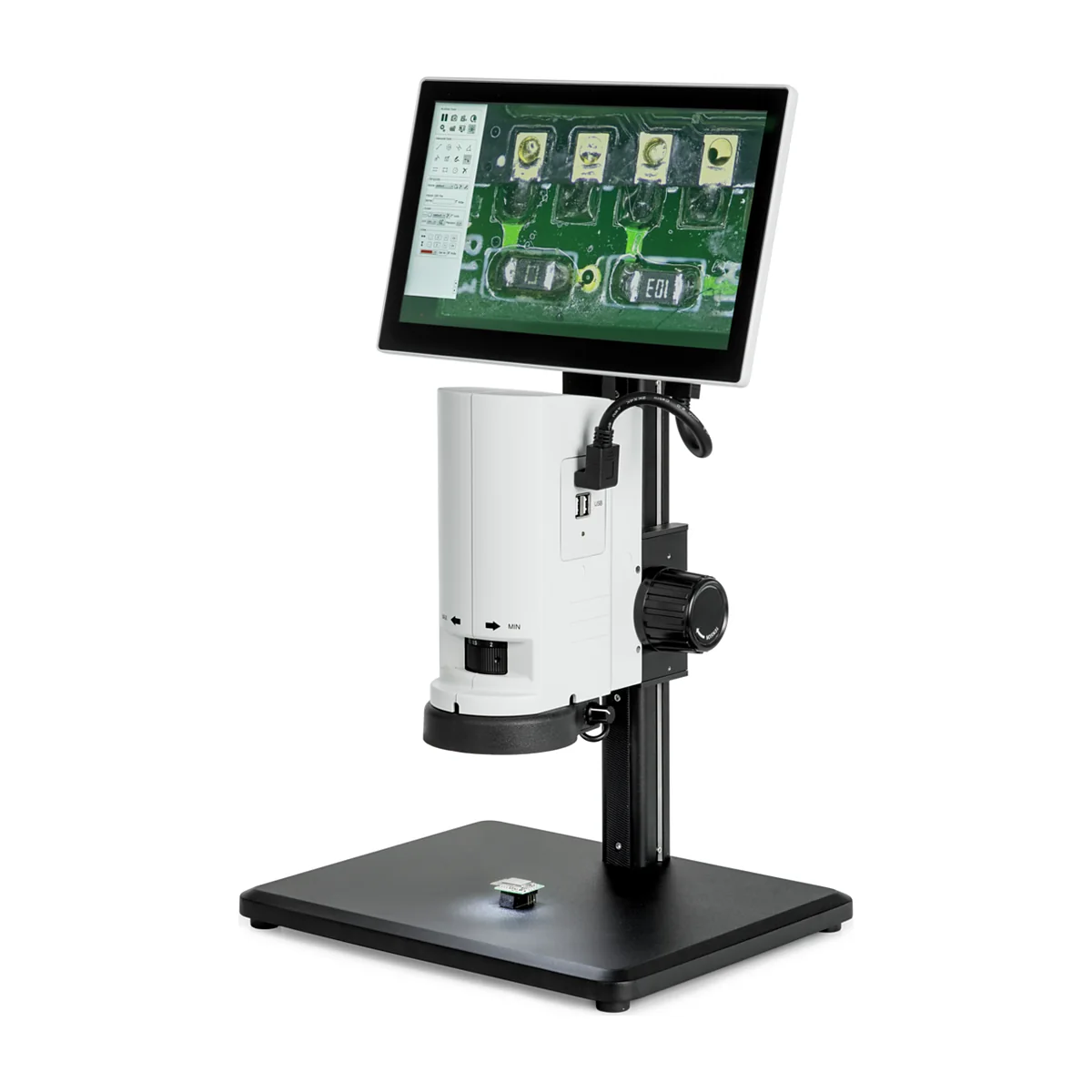
Video microscope (Screen incl.) 0,7-5,0x; 2W LED; Measuring software | Each (OIV 255)
Key features
- All-in-one video microscope with integrated display screen and 2W LED illumination
- 7x to 5.0x zoom lens — no need to change objectives
- Software-controlled image and video capture with extensive measurement functions (diameter, radius, distance, angle)
- Ideal for QC inspection of small parts, PCBs, machined components, and biological samples
- Ergonomic design reduces eye strain vs traditional eyepiece microscopes
Overview
The KERN OIV 255 is a video microscope with integrated display screen, 0.7-5.0x zoom lens, and 2W LED illumination. It comes with measuring software for image and video capture plus dimensional measurement (diameter, radius, distance, angle). The system is designed for non-contact QC inspection and documentation.
Specifications
| Model | OIV 255 |
|---|---|
| Brand | KERN & Sohn GmbH (Germany) |
| Optical System | Video microscope with integrated camera + display |
| Magnification Range | 0.7x to 5.0x (zoom lens, no objective change) |
| Working Distance | 105 mm |
| Illumination | 2W LED, adjustable brightness, multi-angle |
| Display | Integrated LCD screen |
| Measurement Functions | Diameter, radius, distance, angle |
| Software | Image capture, video recording, on-screen measurement |
| Image Output | HDMI and USB device interfaces; 128 GB internal memory |
| Power | 100-240V AC, 50/60 Hz |
| Dimensions (W x D x H) | 320 x 260 x 483 mm |
| Weight | 6 kg net |
| Included | Software, USB cable, calibration slide, dust cover, instruction manual |
Applications
Used in industrial QC labs for inspection of PCBs, machined parts, welds, solder joints, fibers, and electronic components. Also used in biological and medical labs for documentation of dissections, parasite identification, and dental work. Suitable for any application requiring non-contact dimensional measurement with image documentation.
Setup guide
- Place unit on level bench; connect power and USB cable to PC (optional).
- Install measurement software on PC; restart PC.
- Place calibration slide on stage; calibrate software per manual.
- Place sample on stage; adjust zoom (0.7x-5.0x) and focus.
- Set illumination for even lighting; use software to capture image or measure dimensions.
Compatibility
Includes: 0.7-5.0x zoom body, integrated display, calibration slide, USB cable, software CD, dust cover, instruction manual. Optional: ring light attachment; polarisation kit; larger stage; replacement LED modules.
Precautions
Calibrate the measurement software using the supplied calibration slide before taking measurements — uncalibrated readings are inaccurate. Avoid touching the zoom lens surface; clean only with lens tissue and isopropyl alcohol. Power off the unit before changing illumination angle. Do not exceed rated load on the stage (typically 5 kg).
FAQ
What zoom range and working distance does the KERN OIV 255 have?
The OIV 255 has a click-stop zoom from 0.7x to 5x (7.1:1 ratio) with a working distance of 105 mm and a maximum sample height of 100 mm. The field of view runs from about 4.2 mm at maximum zoom to about 29.8 mm at minimum zoom.
Does the OIV 255 include a screen and how is the image output?
Yes, it includes a 12 inch full-HD LCD screen (1920x1080). The 2 MP colour camera with 1/2 inch CMOS sensor runs at 60 fps, and the unit has HDMI and USB device interfaces and 128 GB of memory for images and video.
What lighting does the KERN OIV 255 use?
It has a dimmable 2 W incident-light (reflected-light) LED, so it is meant for opaque samples such as electronic boards, machined parts and welds rather than transmitted-light slides.
Can the OIV 255 be used for measurements?
KERN lists integrated camera software and an image memory function for the OIV 255, but the data sheet does not describe measuring functions. For any dimensional measurement, calibrate the magnification against a certified scale or stage micrometer at the zoom setting used, because measured values depend on a calibrated magnification.