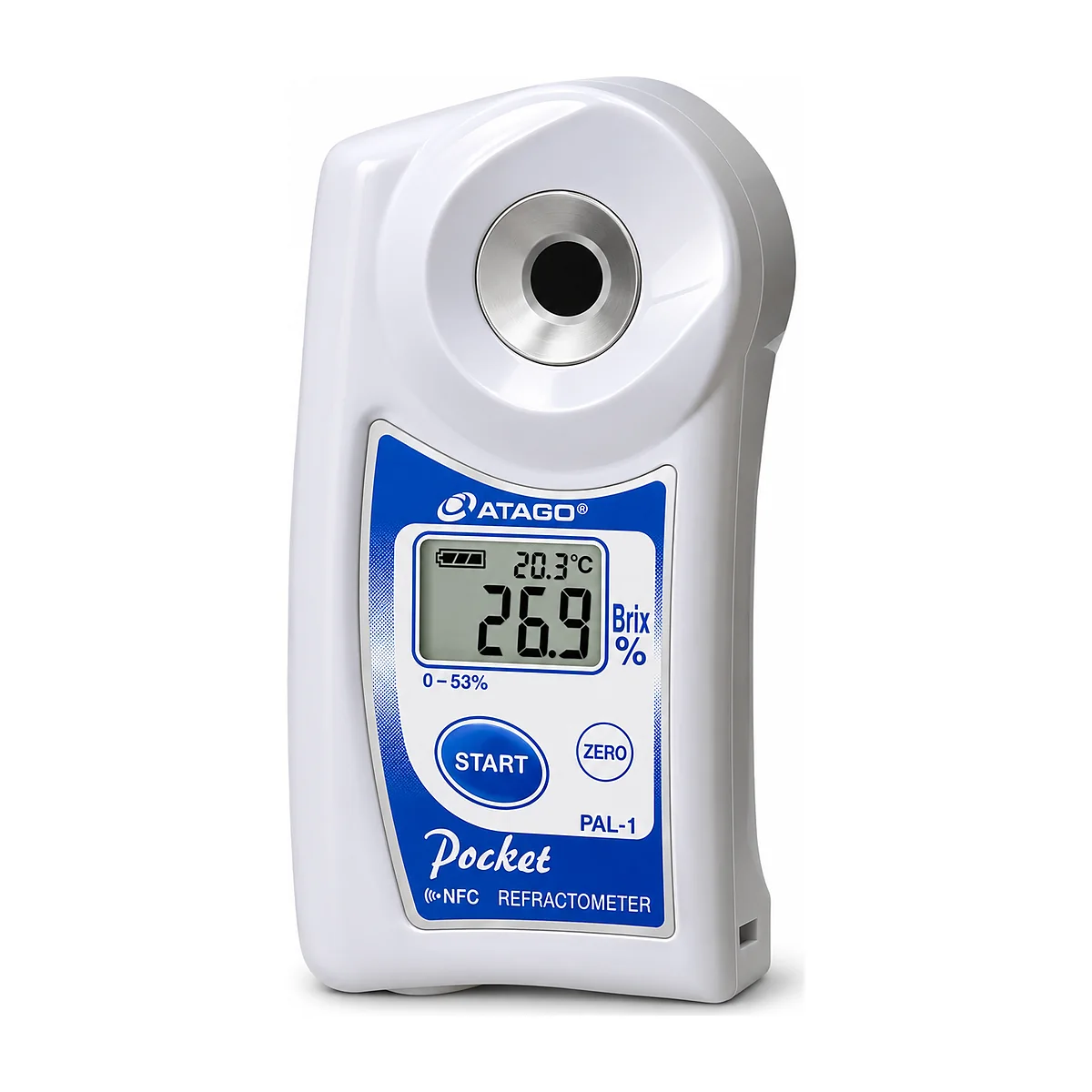
PAL-1 digital pocket refractometer, Brix 0.0-53.0 % (3810)
Price on request
Scichemtech · scichemtech.ae · +971 50 391 6126 · sales@sctme.ae
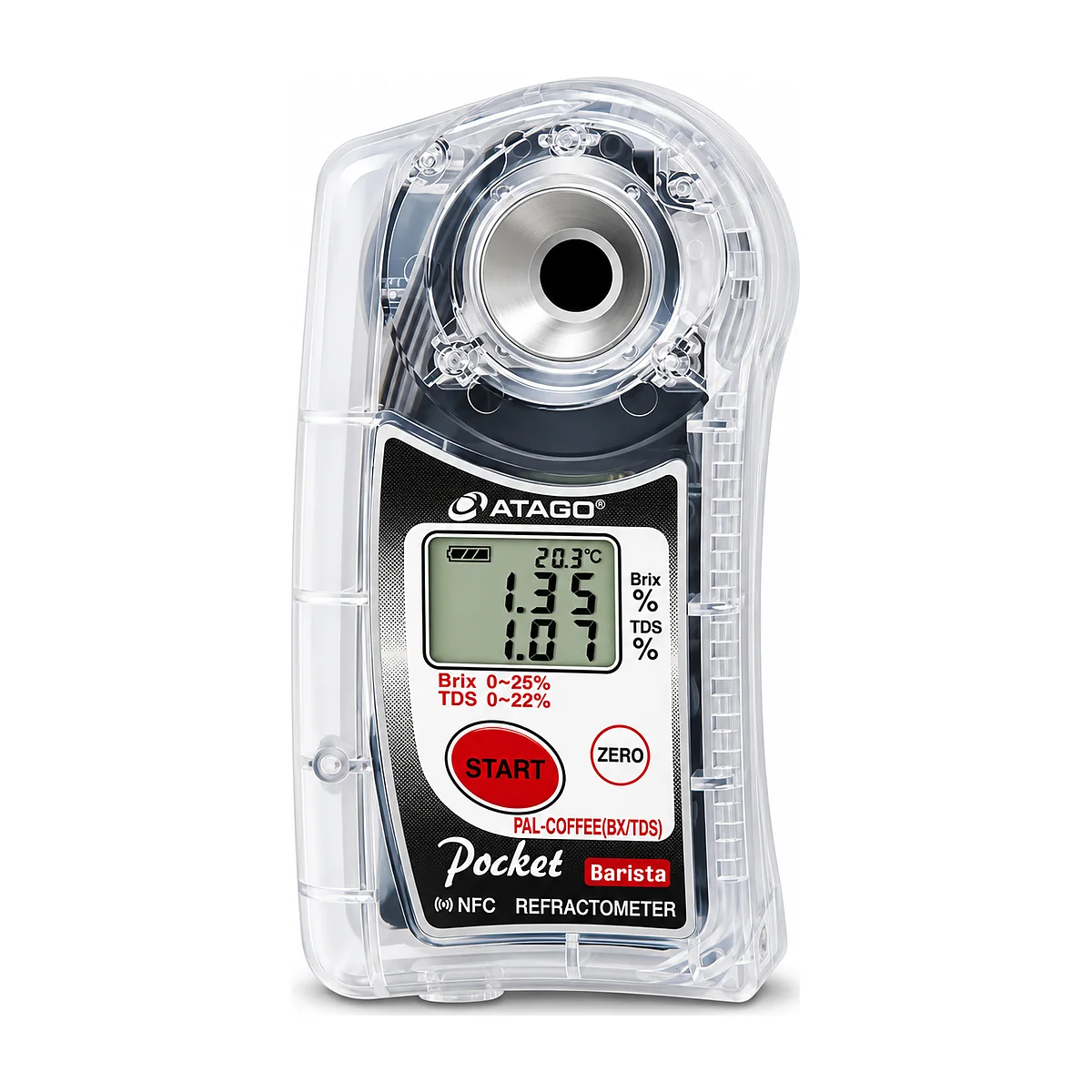
The ATAGO PAL-COFFEE (BX/TDS) is a digital pocket refractometer that measures both Brix and total dissolved solids (TDS) of coffee at 0.01 % resolution. It waits until the sample temperature is read accurately before measuring, giving stable results even on hot fresh brew. Brix or TDS values can be used to calculate extraction yield and keep brewing recipes consistent.
| Product no | 4533 |
|---|---|
| Model no | PAL-COFFEE (BX/TDS) |
| Scale | Brix, TDS (dual scale) |
| Brix range | 0.00 to 25.00 % (ATC) |
| TDS range | 0.00 to 22.00 % (ATC) |
| Temperature display range | 10.0 to 100 °C |
| Resolution | Brix 0.01 %, TDS 0.01 %, temperature 0.1 °C |
| Accuracy | Brix ±0.10 %, TDS ±0.15 %, temperature ±1 °C |
| Temperature compensation | 10 to 100 °C (ATC) |
| Ambient temperature | 10 to 40 °C |
| Sample volume | At least 0.3 mL (2 to 3 drops) |
| Measurement time | About 3 seconds |
| Power supply | 2 × AAA alkaline batteries |
| Protection class | IP65 |
| Dimensions | 55 × 31 × 109 mm |
| Weight | 100 g (main unit only) |
Measuring coffee and espresso concentration (Brix/TDS) to calculate extraction yield in cafés, roasteries and coffee QC labs.
Keep the prism clean, as residue left behind causes erroneous readings. Zero-set only with water at room temperature after the unit has acclimated to the room.
Brix is the sucrose-equivalent concentration derived from the refractive index, while TDS is total dissolved solids in the coffee as a percentage. The BX/TDS model shows both, 0.00 to 25.00 % Brix and 0.00 to 22.00 % TDS. ATAGO uses the concentration reading to calculate extraction yield, and suggests the TDS-only model for controlling coffee concentration in TDS.
ATAGO's example multiplies the concentration reading by the weight of the brewed coffee and divides by the weight of the dry grounds. For instance, 140 g of coffee from 12 g of grounds at 1.8 % gives a 21 % yield. ATAGO notes concentration alone does not always indicate yield.
ATAGO says to stir the coffee gently, since concentration varies during extraction. For French press, let particles settle and avoid the oily surface; for cupping, remove floating grounds and oil. Espresso contains more particles, so fluctuations of about 0.5 % are common.
Zero-set with room-temperature water, making sure both the unit and the water are acclimated to the room. Keep the prism clean, because residue causes erroneous readings, and clean it thoroughly after each measurement, using cotton swabs for the edges.
Resolution is 0.01 % for both Brix and TDS, with accuracy of +/-0.10 % Brix and +/-0.15 % TDS. It needs at least 0.3 mL of coffee, and temperature compensation covers 10 to 100 degrees C, so freshly brewed samples can be read directly.