Scichemtech · scichemtech.ae · +971 50 391 6126 · sales@sctme.ae
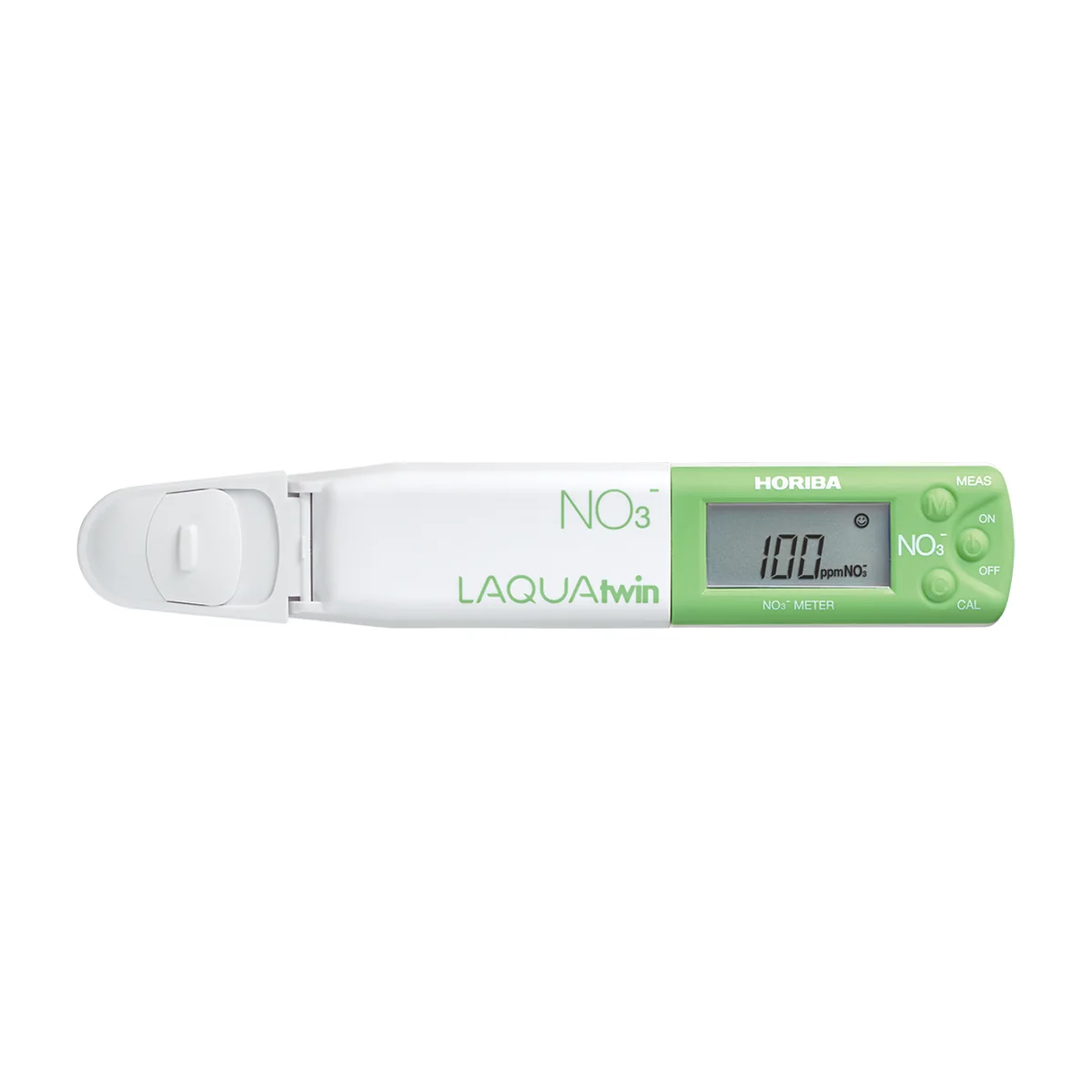
LAQUAtwin NO3-11, Nitrate Ion (NO3-) with plastic carry-case, 14 ml buffer/standard solutions, 2 x CR2032 batteries, dropper | Each (3200689162)
Key features
- Only pocket meter that directly measures nitrate ion (NO₃⁻) concentration from a single drop of sample (≥0.05 ml with sampling sheet B)
- The only pocket meter that directly measures nitrate ion and nitrate-nitrogen concentrations in 0.3ml sample (or 0.05ml sample with sampling sheet B). Unique sensor allows measurement of viscous liquids, solids, and even powder samples. No need for a beaker to calibrate your meter or measure a sample. Just place few drops of the standard or sample onto the flat sensor. This procedure saves you time and prevents wasting your precious sample.
- Minimum sample volume: 0.3ml (0.05ml with sampling sheet B)
- Up to 2 calibration points
- Auto standard recognition
- Changeable high and low calibration values
Overview
The only pocket meter that directly measures nitrate ion and nitrate-nitrogen concentrations in 0.3ml sample (or 0.05ml sample with sampling sheet B). Unique sensor allows measurement of viscous liquids, solids, and even powder samples. No need for a beaker to calibrate your meter or measure a sample. Just place few drops of the standard or sample onto the flat sensor. This procedure saves you time and prevents wasting your precious sample.
Specifications
| Model | NO3-11 (for general use) |
|---|---|
| Measurement principle | Ion selective electrode |
| Minimum sample volume | 0.3 mL (0.05 mL with sampling sheet B) |
| Nitrate (NO3-) range | 6 to 9900 ppm (mg/L) |
| Nitrate-nitrogen (NO3-N) range | 1.4 to 2200 ppm (mg/L) |
| Resolution (6 to 99 ppm) | 1 ppm |
| Resolution (100 to 990 ppm) | 10 ppm |
| Resolution (1000 to 9900 ppm) | 100 ppm |
| Accuracy | ±10% of actual value |
| Calibration points | Up to 2 |
| Temperature display | 0 to 50.0 °C |
| Display | Custom (monochrome) digital LCD with backlight |
| Operating temperature | 5 to 40.0 °C |
| Operating humidity | 85% or less relative humidity (no condensation) |
| Power | 2 × CR2032 batteries |
| Battery life | Approx. 400 hours in continuous use without backlight |
| Material | ABS epoxy |
| Dimensions | 164 × 29 × 20 mm (excluding projections) |
| Weight | Approx. 50 g (excluding batteries) |
| Waterproof rating | IP67 dust / waterproof |
| Functions | Auto standard recognition, Changeable high & low calibration values, Temperature calibration, Multiplication compensation, Auto hold / Auto stable measurement, Switchable backlight, Automatic power off (30 min), Low battery indicator, Replaceable sensor |
Applications
Used for direct measurement of nitrate (NO₃⁻) and nitrate-nitrogen (NO₃-N) in plant sap, soil extracts, fertigation water, vegetables and forage. Widely used in precision agriculture for nitrate management, in environmental water monitoring, and in food quality control (e.g. leafy-vegetable nitrate screening).
Setup guide
- Insert 2 × CR2032 batteries into the meter (battery compartment on the back).
- Remove the sensor cap and apply a few drops of the 150 ppm standard onto the flat sensor; press the calibration key and wait for the meter to auto-recognise the standard.
- Rinse the sensor with DI water, then apply the 2000 ppm standard and repeat the calibration.
- Rinse again, then apply 0.05-0.3 ml of the sample (use sampling sheet B for 0.05 ml volumes).
- Wait for the auto-stable indicator and read the concentration in ppm.
Compatibility
HORIBA LAQUAtwin 4M Kit (1300083234); HORIBA nitrate standard solutions (150 ppm and 2000 ppm, 14 ml bottles); HORIBA sampling sheet B (Y046); CR2032 batteries; HORIBA rinse bottle (60 ml).
Precautions
Handle the flat sensor carefully — do not scratch the ion-selective membrane with sharp or abrasive objects. Always rinse the sensor with DI water after measuring corrosive or high-ionic-strength samples. Replace the sensor cap when not in use to prevent dehydration of the membrane. Use only HORIBA-recommended standard solutions for calibration.
FAQ
What is the difference between nitrate and nitrate-nitrogen readings on the NO3-11?
The NO3-11 reports nitrate (NO3) from 6 to 9900 ppm and nitrate-nitrogen (NO3-N) from 1.4 to 2200 ppm. Nitrate-nitrogen is about 0.23 of the nitrate figure, since only the nitrogen mass is counted. Agricultural recommendations often use NO3-N, so confirm which unit your target value uses.
How do I calibrate the NO3-11 and which nitrate standards does it use?
By default it uses the 150 ppm and 2000 ppm nitrate standards, recognised automatically. Rinse and dry the sensor, cover it with the first standard, close the cover and press CAL, then repeat for the second. HORIBA also lists 30, 300 and 5000 ppm nitrate standards if your samples are very low or high.
What interferes with nitrate readings on the NO3-11 and what pH is allowed?
HORIBA lists iodide, nitrite, bromide and chloride as interfering ions, with iodide the strongest (selectivity coefficient 10) and chloride the weakest (4 x 10 to the minus 2), and specifies a pH of 3 to 8. High chloride or nitrite samples may therefore read high.
What samples can the NO3-11 measure and how much is needed?
A minimum of 0.3 mL, or 0.05 mL with sampling sheet B, placed directly on the flat sensor. It handles liquids and also viscous samples, solids and powders, so plant sap, soil extracts and nutrient solutions can be tested without a beaker. Use sampling sheet B with its holder for extracts that contain fine particles.
How do I replace and store the NO3-11 sensor?
The sensor is a replaceable consumable part; HORIBA lists sensor S040 (article 3200459870) for the NO3-11. Rinse with water after use, dab it dry, close the cover and store at room temperature. After several days of disuse, condition it with drops of 2000 ppm nitrate standard for a few hours, then recalibrate.